


Warrior RACE obstacle Course Preview
Avalanche
Sprint up a steep ramp and haul yourself over the top, with or without a net.
How to do it
Run hard and fast up the ramp, driving your knees high to maintain momentum. Reach for the edge and pull yourself over. If the net is available, lean back into it and climb steadily to the top. Don’t hesitate mid-run; commitment is everything here. Your teammates or a stranger’s helping hand can make all the difference.
How to train for it
Practice explosive hill sprints to build the leg power needed for the ramp. Complement this with pull-up and dead hang progressions to strengthen your grip and upper-body pulling ability.
FAQ
Q: What if I can’t make it up the ramp on my own?
A: Ask a teammate or another racer for a boost; this is completely allowed and very much part of the Warrior spirit.
Q: Should I use the net or go straight over the edge?
A: If the net is available and you’re unsure, use it. If you’re confident in your momentum, go straight for the edge; speed is your best friend here.
Q: What’s the biggest mistake people make?
A: Slowing down or hesitating halfway up. Once you commit to the run, keep going, stopping on the ramp makes it significantly harder to finish.
MUD MONSTER
The biggest, muddiest obstacle on the course, climb, slide, and crawl your way through.
How to do it
Climb up and over the mound on one side, slide down into the mud pool, then crawl through to the other end. The course layout varies, sometimes flat, sometimes hilly, often both. Expect it to be slippery, sticky, and slow-going. Pace yourself and keep moving forward, no matter what.
How to train for it
Build muscular endurance with high-rep crawling drills like bear crawls and army crawls to prepare your body for prolonged low-to-the-ground movement. Add hill climbs or stair repeats to handle the unpredictable terrain variations.
FAQ
Q: Will I definitely get muddy?
A: Absolutely, there is no clean way through this one. Embrace it.
Q: What should I wear for this obstacle?
A: Fitted, moisture-wicking clothing that won’t weigh you down when wet. Avoid loose layers that will collect mud.
Q: What if I get tired halfway through?
A: Take a breath, reset your mindset, and keep moving, even slowly. Stopping completely makes it psychologically harder to finish.
Balance Beams
A test of focus and balance, navigate narrow beams while weaving under hanging tires.
How to do it
Pause before you start. After running, your body will be shaky and your balance compromised. Place one foot directly in front of the other, keep your arms out for stability, and breathe steadily. Duck under the tires without losing your footing. If you’re with a team, hold hands for added balance support.
How to train for it
Practice single-leg balance exercises like single-leg stands and slow step-ups to improve your stability under fatigue. Add yoga or balance board training to develop the body awareness needed when your legs are already tired.
FAQ
Q: Can I use my arms to steady myself?
A: Yes, extend your arms out to your sides like a tightrope walker for maximum balance.
Q: What if I fall off?
A: Simply step back on and continue. There’s no penalty for falling; just keep going.
Q: Why does this feel harder mid-race than it looks?
A: Running spikes your heart rate and causes muscle fatigue, both of which significantly impact your balance. Slowing your breathing before you start helps reset your nervous system.
Mamba
A 5-metre-high slide into a 2.5-metre-deep pool, a true test of nerve, height, and deep water.
How to do it
Climb up to the top of the 5m structure via the net, take in the view, and prepare yourself mentally. Hold your breath, slide down the ramp, and splash into the deep water pool below. Once in, swim confidently to the exit. This obstacle is mandatory for Elite athletes; all others who skip it will incur a time penalty.
How to train for it
Work on your swimming endurance with regular pool sessions, focusing on confident water entry and calm, controlled swimming after submersion. Practice controlled breathing exercises to manage the instinct to panic when entering water at speed.
FAQ
Q: Do I have to complete this obstacle?
A: Elite athletes must complete it to qualify. Other categories can skip it, but will incur a penalty.
Q: What if I can’t swim well?
A: If you’re not a confident swimmer, skip this obstacle; the pool is 2.5m deep, and safety must come first.
Q: Is there anything that helps with the fear of heights?
A: Focus on the slide itself rather than looking down. Once you’re moving, the momentum takes over, and the anticipation at the top is always worse than the slide itself.
Wall of China
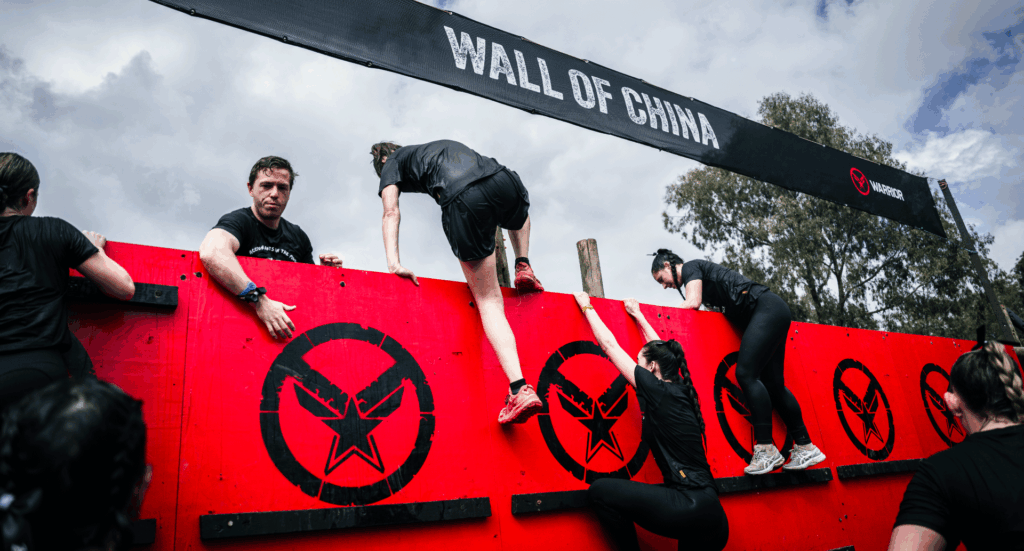
A 2.5-metre wall to scale up and over, heights included.
How to do it
Approach the wall and use the horizontal leverage sections as footholds and handholds to climb up one side. Once at the top, take a breath and carefully scale down the other side one step at a time. There’s no need to rush; controlled, deliberate movement is safer and more effective than speed.
How to train for it
Develop upper body and grip strength through regular pull-up and assisted climbing training. Practise box climbs and wall-assisted movements to get comfortable with the mechanics of scaling vertical surfaces.
FAQ
Q: How tall is the Wall of China?
A: It stands at 2.5 metres, roughly the height of a standard single-storey ceiling.
Q: What’s the safest way to get down the other side?
A: Face the wall as you descend, use the footholds, and lower yourself in a controlled manner rather than jumping down.
Q: Can teammates help each other over?
A: Absolutely, a boost from below or a hand from above is a great team strategy.
Chain Reactor
Hoist a heavy tyre to the top using a chain pulley system, then bring it back down under control.
How to do it
Grip the red handlebars and pull to hoist the tyre upward. The key technique is to lean back, use your body weight as a counterbalance, and drive power through your legs rather than just your arms. Lowering the tyre back down is the harder part. Engage your core, brace, and resist the urge to let it drop quickly.
How to train for it
Incorporate rope pulls, resistance band rows, and dead hangs into your routine to build the pulling strength and grip endurance needed. Add core stability exercises like planks and hollow holds to prepare for the controlled lowering phase.
FAQ
Q: Why is lowering the tyre harder than hoisting it?
A: Eccentric (lowering) movements require your muscles to resist load under tension — this fatigues differently than pulling and catches many people off guard.
Q: What muscle groups does this target?
A: Primarily your back, biceps, and core — with your legs playing a crucial supporting role in the leverage technique.
Q: Any tips for not burning out my arms too quickly?
A: Lean back and let your legs and body weight do the work. The moment you try to muscle it with just your arms, fatigue sets in fast.
Tarzan
Swing on a T-bar, ring the bell, and make a splash.

How to do it
Grab the T-bar and swing forward with momentum. As you approach the bell, allow your swing to carry you toward it, then release one hand and strike the bell with your hand or feet. Let go of the bar and drop into the water below. Swim around the pole to complete the obstacle, and just like that, Bob’s your uncle!
How to train for it
Build grip strength and swing confidence with hanging bar work, including dead hangs and controlled swings. Combine this with swimming practice to ensure you’re comfortable entering and moving through water after the drop.
FAQ
Q: Do I have to hit the bell to complete the obstacle?
A: Yes, ringing the bell is the objective. Use your momentum wisely; don’t swing too fast or you’ll overshoot it.
Q: What if I drop before hitting the bell?
A: You’ll need to swim to the exit and may incur a penalty depending on your race category. Check the rules specific to your wave.
Q: Is this obstacle suitable for non-swimmers?
A: You do need to be comfortable in water to complete this one safely, as you’ll need to swim to the exit after dropping in.